I was recently informed that my name was mentioned in an Ohio State Gaming Commission memorandum, even though I have never been to Ohio so naturally my interest peaked …. And after making a few phone calls I was able to narrow the source down and make contact with the person that had obtained some documents under the Open Records Act.
There was a Memorandum from the Assistant General Counsel of the Ohio Casino Control Commission (OCCC) that referenced my name and cited this website ( http://crapsadvantageplayers.blogspot.com/ ) … below are some of those papers, with information and names of the innocent redacted.
These real documents read like a bad Hollywood script of "Comedy of Errors" - see how many technical snafus made by the supposedly independent Casino Control Commission you can find ... (after reviewing these documents and having more than 8 hours of interviews with the craps player involved, my comments have been added in red and emphasis highlighted in light red, the original documents included yellow highlighting)
…. Is this a perfunctory investigation by amateurs in a manner that is incomplete, incompetent, lacking of analytical abilities, unprofessional and can only be described as an inadequate, negligent performance of government administrative, fiduciary and enforcement responsibilities or maybe is just an orchestrated cover-up of the actual facts of unbalanced dice in live casino play. This dice inspection is being supervised and directed by an attorney (Assistant General Counsel) so either is possible -- you decide.
Some dates have been highlighted to let you decide what took so long to occur behind closed doors – Also note that the original case was marked CLOSED in the field at the Casino after reviewing the dice, surveillance video, talking to the Boxman that tested the dice and the Gaming Agent made a recommendation that the case be closed. HOWEVER, this case was REVERSED at the Headquarters Ohio Casino Control Commission:
- Without even interviewing the Boxman or patron and
- Ignoring the overwhelming surveillance video and
- Ignoring the biased results of the dice on the table and THEN
- Ignoring the actions of the Casino to remove the dice from play and
- NEVER “officially” testing the evidence themselves with a dice balancing caliper
Without "officially" meeting with the lead field Agent. Even though this case took over 52 days to settle, the headquarters division conveniently never "officially" met with the original on-site Gaming Agent that wrote the Initial Report and did the initial investigation and recommended this case Closed in this following Initial Report:
___________________________________________________________________
OCCC ACISS Case Management System: Initial Report Report Inquiry (XX-1093)
Initial Report Report: XX-1093
Primary Information
Report Number: XX-1093
Case Number: XX-1093
Case Status: CLOSED
Case Lead LEO: Chapman, Kyle
Type Of Report: Initial Report
Report Date/Time: 09/13/20XXXX 0:00
Description: Player Dispute
Reporting LEO: Chapman, Kyle (Cincinnati / Ohio Casino Control Commission)
Occurred From: 09/13/20XXXX 6:15
Occurred To: 09/13/20XXXX 9:10
Source Of Info: XXXX
Source Reliability: XXXX
Dissemination: SYSTEM WIDE
Approved By: Koeppe, Stu (Cincinnati / Ohio Casino Control Commission)
Approved Date/Time: XXXX
Approval Status: Approved
Expense Status: Not Posted
Synopsis
On 09-13-XXXX (wrong year is typed in this Report) a patron playing at craps Table 306 disputed that the dice in play were out of balance and requested them to be changed. A new set was brought in and calibrated/checked on the table in front of the patron. He claimed the new set was out of balance and asked for another set. (To clarify, the Casino Boxman determined that all these sticks of dice were unbalanced by properly using the caliper, not the patron.) The third set was also found to be out of balance (by the Casino Boxman). The fourth checked ok and were introduced to the game. The patron wanted to file a dispute form with the OCCC. (The patron did not want to file a complaint until after the Shift Manager refused to retest the dice on the hard surface of the chip bank cover or the podium in the pit, and then refused to reimburse the patron for his losses due to unbalanced dice being used by the casino in violation of state law as noted below. The patron was aware that the inspection is required to be conducted on a hard surface [ Note: see patron's filed complaint; and, this was the subsequent reason for dismissing the tests conducted at the table by the boxman, which actually did not distort the conclusion of the tests performed on the felt layout of the table.] ).
Related Addresses
Address Relationship
1000 Broadway Street Cincinnati, Ohio 45202,
Horseshoe Casino Cincinnati, Cincinnati, OHIO, 45202 OCCURRED
Charges
Offense Type Offense Attempted/Committed Statute UCR Class
1. Regulatory - Patron Complaint / Dispute NOT APPLICABLE REG UCR
Related Subjects
Name Relationship Type Sex Race Age DOB
XXXX XXXX XXXX XXXX XXXX XXXX XXXX
Related Property
Property Class Property Type Description Prop Status
1. EVIDENCE Miscellaneous - Sleeve of 5 red dice from table 306 - EVIDENCE/SEIZED
(Note – the 2 other sleeves listed from this Initial Report’s Synopsis above are missing from EVIDENCE – why - as Ohio Administrative Code (OAC), highlighted below clearly indicates they should be removed from play.
Where is the casino's discrepancy report, as later noted by Mr. Martin, the Ohio Director of Regulatory Compliance in an email ?? This requirement was even highlighted in yellow by the Patron in the OAC he attached to his Complaint. )
2. LOST US Currency $XXXX USD lost at craps table 306 ---
Narrative
On XXXX, at Craps Table 306, XXXX was playing the game for about an hour according to statements, when he asked the boxman (supervising dealer) of the table to test the dice being used in play. His reasoning for the request was that certain combinations of the die were showing up more frequently than others and this made him suspect that the dice were not 'balanced.'
Testing of the dice began at the table, on the table felt around 8:55 hours. Via XXXX XXXX's statement and surveillance footage, the dice that were in play at the time were taken off the table due to faults (the Casino Boxman determined that all these sticks of dice were unbalanced by using the caliper). Two more sleeves of die (dice) were also tested by the Boxman and both of those, as well were deemed to have faults (determined that all these sticks of dice were unbalanced by properly using the balancing caliper) and were taken out of the game.
The fourth sleeve tested ok and were introduced to the game. During the testing OCCC agents were requested. Contact was made around 1000 hours. XXXX alleged the dice he was using and other players were 'unbalanced.' Those dice were seized by agents as evidence for a regulatory matter. He went on to state the other sleeves tested after were 'unbalanced' as well. XXXX was given a dispute form and was advised he could bring the form back to us or mail a copy to Columbus. He stated he would, and requested that his $XXXX he lost on the game be returned for the dice being out of compliance (attached is the casino CMS record indicating a lost of $XXXX on XXXX).
He was advised to speak with the Casino about that matter and that the OCCC could not make that determination right then and there.
As related above, the Casino did find the disputed dice to be out-of-balance, as well as two new sleeves of dice, therefore I recommend this case be Closed, Transferred to Regulatory Compliance.
Attached are: Casino CMS records of play and loss, OCCC Dispute form, OHLEG printout. Also, video of the complainant's play has been flagged.
Attachments
Description Size Mime Type Record Origination
1. OHLEG (ohleg.pdf) 237 KB application/pdf XXXX
2. Dispute Form (disputeform.pdf) 12,660 KB application/pdf XXXX
3. Casino CMS Record for XXXX (cmsrecord.pdf) 18 KB application/pdf XXXX
View Image Report
Record Status Information
Record Origination Operator: Chapman, Kyle (Cincinnati / Ohio Casino Control Commission)
Record Origination Date: XXXX
Last Update Operator: Koeppe, Stu (Cincinnati / Ohio Casino Control Commission)
Last Update Date: XXXX
ACISS software licensed by Ohio Casino Control Commission
msiba XXXX XXXX
___________________________________________________________________
From: Siba, Michelle
Sent: XXXX
To: Patrick Martin; Donahue, Craig (Craig.Donahue@casinocontrol.ohio.gov); Dempsey, Teresa (Teresa.Dempsey@casinocontrol.ohio.gov); Flora, Carrie (Carrie.Flora@casinocontrol.ohio.gov)
Subject: FW: XXXX incident report
The promised patron dispute regarding dice in Cincinnati.
From: XXXX
Sent: XXXX
To: Siba, Michelle
Subject: XXXX incident report
Hi Michelle:
I'm attaching the OCCC Incident Report that has 10 pages included. It is in Adobe PDF format. I also have mailed a certified copy as per our phone conversation and may drop off a copy to Agent Chapman at the casino.
I did forget to mention in the report that when I asked about the serial numbers on the 4 sleeves that were tested, the boxman stated that they were all 4 different colors. That could be useful viewing the video record.
I also would like to know how many sleeves have been rejected since the Horseshoe opened here in March, XXXX and can't help but wonder the same about the other three Ohio Casinos.
I'm aware that one floor supervisor at the Lawrenceburg Hollywood was rejecting over half the sleeves she inspected due to balance issues; and that is the same owner of the Toledo and Columbus Casinos, Penn National Gaming. I imagine the Ohio Hollywoods use the same brand dice. She was one of the few casino employees that I have witnessed that was competent.
I look forward to seeing the determination of your work.
Sincerely,
XXXX XXXX
___________________________________________________________________
Original Patron Complaint filed with the Ohio Casino Control Commission
___________________________________________________________________
This incident occurred on XXXX morning XXXX, approximately from XXXX at the craps table of the Horseshoe Cincinnati Casino. The following description of events are to the best of my knowledge and recall as to what occurred and the actual events can be verified by casino surveillance video. I began play on table number CR 20-306 alone but was soon joined by a few other players over an hours play. I noted to the dealers during my first six or seven turns the point of 10 or 4 was established , mostly the 10, and that was very strange and unusual. I also noticed that there were many 4s, 10s and horn numbers being tossed, many more than the statistical probability; so much so, that there were comments being made by the other players and myself. I also noticed that there were many more 7s coming with the 5 face and the 2 face; this occurred frequent enough that I wanted the dealers and boxman to be aware of this, so, I stated, that when this happened in many of the Las Vegas casinos, where there are no dice specification laws or regulations, the dealers would announce “cinco dos, adios”!
I must have announced this 5 or 6 times as it continued to occur. I finally was sure that this sleeve of dice was clearly biased and not balanced. I then asked the boxman if he would have these dice tested for balance with the balancing caliper and that if the test was administered properly we could prove why we were seeing all the unusual numbers being rolled and less inside numbers, or the proper statistical pyramid distribution of numbers.
I told him that I have seen dice sleeves being tested here before and that the balance test was seldom done correctly with the intent to confirm that the dice were balanced, but mostly just going through the motions. I explained to him that if he would let me test the dice, I could show how it should be done to confirm balance and disclose if a die were not balanced as required for a fair game and in accordance with Ohio Administrative Code (3772-11-20 Dice specifications (A)(6)). To his credit, he told the floor supervisor that I believed the dice were biased and out of balance. To the floor supervisors credit, he brought a square and balancing caliper to the table and told the boxman to test the dice. Of course, they were not going to allow me to conduct these tests, but the boxman proceeded to conduct the tests by allowing me to instruct him on the procedures while explaining why it is the correct way to determine if the die is out of balance and to what degree. I told him that I have seen dice sleeves tested all over the country and have seen it done incorrectly too many times. The first die tested was observed as it slowed to a stop, it then changed the direction of rotation and went backwards about 90 degrees, stopped, changed direction of rotation, again backwards a little less than 90 degrees, stopped, again changing direction of rotation approximately 45 degrees, stopped and again rotated in the opposite direction. I told him to stop and note that this die stopped and changed rotation direction 4 times and that is a result of the heavy side of the die seeking to come to rest on bottom of the axis it is spinning on. I also told him to note that the one (1) pip was facing upward, and that I suspected that this die was out of balance and the six (6) pip face was heavy; and , we should spin it again to confirm this. The exact result occurred, changed rotation direction 4 times and the one (1) pip face was up when it came to rest. I asked him to confirm this again by spinning the die in the opposite direction. He did this and got the exact same result two more times, 4 direction changes of rotation and the one (1) pip upward. I then asked him to note that the three (3) pip face was positioned so as to be perpendicular to the balancing caliper, which he agreed. I then explained that if we were to remove the die and place it back in the balancing caliper so that it would be parallel to the caliper, we would then have two different opposite corners of the die and a different axis in which to perform a spin balance test to confirm that which we already knew.
After trying twice to position the die this way and get it adjusted where it wasn't too tight and allow it to spin freely, he conducted two more tests, spinning the die in different directions and did get the same result, changing the rotation direction after stopping 4 times before coming to a stop with the one (1) pip face up. He was convinced that this was a valid procedure and concluded this die was extremely out of balance. He proceeded to the second die to test and we placed the first unbalanced die to the side with the one (1) face up. The second die also was extremely unbalanced as proven by following the same procedure. It also changed rotation direction 4 times and came to rest on the same pip face up and was done on a different axis with the same conclusion. The next two dice were also out of balance, stopping with the same pip faces up on different axis tests; while they didn't change rotation directions 4 times, we agreed that they were not fit for fair play as required. The fifth and last die was also in this category but to a lesser degree.
The floor supervisor then came over to the table and the boxman told him that he did have a problem with these dice and they were out of balance. I asked him if I could have my money back and that I had lost $XXXX of my $XXXX buy in playing with dice that were not in accordance with Ohio Administrative Code (3772-11-20 Dice specifications (A)(6) Have its weight equally distributed throughout the cube, with no side of the cube heavier or lighter than any other side of the cube).
He told me he was contacting the manager or shift manager. In the interim, he brought another sleeve of dice to the table and I asked if they could be tested. They were, and these also were biased out of balance. I noted to the boxman after he tested the first die in this sleeve, since we see that it is not balanced, normally when these tests are done, this would be reason enough to reject the sleeve since they are all the same serial number and its required to offer the player five fair dice to choose from. He did test the rest of the sleeve finding more unbalanced dice. At this point the floor supervisor brought another sleeve, and this one also was not fit for fair play due to unbalance. The fourth sleeve was tested and concluded were fair.
After waiting some time,XXXX , the shift manager, arrived at the table and was informed.
He stated that the dice were in play more than 3 hours and they could have changed. I told him he was wrong and that I was told when the dice were put in play, as I had asked when playing and there never more than 4 players on the table. He then stated that the balancing caliper was sitting on the felt layout and the test must be done on a level surface. I told him it is true that it is usually done on the bankroll cover or at the podium, but the table is level and these dice tested so out of balance that I would be happy to see them tested again, and that he apparently didn't want to hear what had occurred here; and that I will have to follow through with a complaint and would like to speak to a Gaming Commission Agent. At some point I was informed that this was being observed on the camera and the Gaming Commission Agent was on the way. After some long period, I noticed the Floor supervisor, shift manager, and three Gaming Commission Agents conversing in the end of the pit near an adjacent closed craps table. After waiting a while, I showed the boxman that I had lost $XXXX and had $XXXX in chips remaining for the record, and walked over near the closed table. The shift manager introduced the Agents to me and went back into the pit. I explained all the details to them and also told them of my experience and background and why I know so much about dice. I was given the Ohio Casino Control Commission complaint or incident form and told it could be turned in to them or sent to Columbus. After approximately a 30 minute conversation with the Agents concluded, I went back over to the pit to talk to the shift manager again and asked him if I could be reimbursed the $XXXX that I had lost on the table where it was determined the dice were biased and were not in accordance with Ohio Administrative Code. He told me that it depended upon what the investigation determination and outcome results are. I decided not to dispute that, even though it was already concluded that the dice were out of balance and not fit for fair play, and he has the authority to make that decision.
Later that day, I realized that the Agent had the dice that were played with in a sealed plastic bag, but, I didn't see the other two sleeves of dice that were also tested and determined to be out of balance and not suitable for fair play in his possession. I realized that in accordance with Ohio Administrative Code 3772-11-21 Dice; receipt, storage, inspections, and removal from use. (F)(1) The casino operator shall remove any dice from use if there is any indication of tampering, flaws, or other defects that might affect the integrity or fairness of the game, or at the request of the commission gaming agent on duty. That and having told him I would send him a copy of the test procedures that were followed to determine the balance and that I had it in written form, I sent him the following email:
Biased dice due to imbalance XXXX
From: XXXX XXXX
Date: XXXX Sep 13, 20XXXX at 2:13 PM
Subject: Biased dice due to imbalance 9/13/20XXXX
To: kyle.chapman@casinocontrol.ohio.gov
Hi Kyle:
Thank you for allowing me the time to explain my complaint and observations to you today. I'm including an explanation of how I instructed the Boxman to test the dice for balance this morning.
May I suggest you preserve the digital recording of the play and the testing of dice that I requested on the table this morning. By the way, it should be noted the he actually didn't find an acceptable sleeve of balanced dice until the 4th sleeve he tested.
The next two sleeves he tested were also unbalanced enough that he concluded they were not acceptable for play and perhaps you should also take possession of them too.
I was also disappointed that the Shift Manager didn't make a decision to reimburse me the $XXXX I had lost after the test was conformation that concluded the dice were unfair and extremely out of balance. I believe if you three Agents review video, you will see why I asked that the dice in play should have been tested and you will also see that the Boxman followed how balance tests with the Balancing Caliper should be conducted and that all five dice clearly failed.
Since all sleeves are required to be tested on camera, I also strongly ask that you review the video of these tests when they took place. I'm sure you will conclude as I have observed that testing for balance is completely inadequate and mostly done without training and knowledge and just going through the motions without meaning. How else could these three sleeves be approved for play in an unfair condition? Like I have observed, it is an industry wide problem as this is common in the majority of casinos.
I will follow up by filling out the Form you gave me, though it may take a while to do a thorough and complete explanation.
I also want to convey and commend the Boxman and Floor Supervisor for actually listening to my request and questioning the fairness of the dice in play, as it is important that the public and players know the game is fair. Hopefully it can be a practice that can be standard when they know the player is knowledgeable.
If you have any reason to contact me, my cell is XXXX.
Thanks again.
Here is a balance testing procedure to instruct how to detect biased dice due to not being in perfect balance as required in state gaming regulations to present a fair game to the public.
____________________________________________________________
The degree of imbalance in a die is variable, but if it can be determined that there is any imbalance in a die, it and the entire sleeve of matching serial numbers must be rejected for acceptance and use to comply with the balance requirements in the Regulatory Language.
1. The Balancing Caliper shall be placed on a solid flat level surface to conduct the tests. (ie. the table bank roll cover).
2. There are two methods that can be used to place the die into the cups of the Balancing Caliper. The first can be used mostly for speed and ease in performing the general balance testing - the opposing corners of the die shall be placed in the cups of the Balancing Caliper while adjusting the cups to allow the opposing corners to rest loosely near the bottom of each cup and with the axis between the two opposing corners as level as possible. Proceed with the test as stated in #s 3, 4 and 5 as follows, except when an imbalance is suspected.
If an imbalance is indicated or suspected while performing the test by the first method, the test shall proceed using the second method that differs only by more careful placement of the opposing corners as near to the center of the cup and careful adjustment of the cups to allow the die to rotate freely without slowing and affecting the spin rate, yet maintaining the axis between the opposing corners to remain as level as possible when conducting tests as stated in #s 3, 4 and 5 as follows. This second method is more precise because the opposing corners are rotating and sitting on a more vertical surface of the balancing calipers cups.
3. Spin the die and observe that it is spinning freely with the spin rate not being affected by the cups being too tight to effect a slower spin rate. This rate does not have to be fast, and an imbalance will show itself on how the spinning die comes to a stop.
4. A balanced die will come to a slow stop and it will not stop and reverse direction and then spin in the opposite direction. An imbalanced die will stop spinning and reverse the spin direction and rotate in the opposite direction, and could stop again and rotate in the opposite direction again and again. This is the heavy imbalance side of the axis seeking its bottom in relation to the Balancing Caliper. The tester must observe which numbered face comes the closest to an upright position in relation to the Balancing Caliper, and then,
5. Proceed to spin the die again in the opposite direction as the first test spin while observing the same as stated in #s 3 and 4.
Note if the die reverses spin rotation again and which the same numbered face is most upright again. Many times it will be the same face that is most upright, or the same face will be the second most upright. In which case,
6. The die must be removed from the Balancing Caliper and retested with different opposing corners. The tester must be looking for similar results as the previous tests and must follow the same procedures as above.
7. It has been determined in #s 4,5 and 6 above that the die is imbalanced and the sleeve must be rejected. There is no need to test the remaining dice in the sleeve of matching serial numbers. The rejected die must be identified and noted which numbered face(s) was coming the most upright when the die came to rest. Then follow the procedures for rejecting dice from play.
____________________________________________________________
I am XXXXXXXXXXXXXXXXxxxxx the last ten years was employed as a XXXXXXXXX certified test technician.inspections and I was trained and experienced with testing procedures and performed tests in the field that XXXXXXXX. I have been playing craps for close to 30 years and have three generations of relatives employed in the casino business. (This Patron readily disclosed that he has the qualifications, experience and background to observe, analyze, conclude and file a complaint to be taken seriously. He even offered recommendations to resolve these problems in the future to provide unquestionable fair play.) I am acquainted with many craps players all over the US and have noticed that in the last five years there have been changes in the craps game that is alarming and have been closely observing the cause of these changes. Three of us have even gone to a gaming manufacturing plant in Las Vegas, Nevada to see their process; where the plant manager took 3 sleeves off the line and demonstrated all the tests that are performed for quality control. When he finished, we noted that he did not test for balance. He stated he was not required to do so.
Since these were precision dice sold and used in many casinos, we asked if we could test them for balance; which he agreed. We used the same balancing caliper used in all the casinos and concluded that three dice in each of the three sleeves were biased and out of balance, not fit for fair play. While he acted surprised, I don't believe any changes were made. This was over three years ago and that plant manager was sent to Mexico to set up and move the manufacturing of their dice there. The dice in this incident are TK brand, were manufactured in Mexico by GPI Gaming, which also sells Bud Jones and Paulson brand dice. I believe Midwest dice are one of the last made in the USA. Noting these changes at the craps has led us to discover an alarming increase in the casinos win percentage on the craps tables over the last 4 to 5 years. I believe this is associated with the quality decline in the dice used today, especially in the unbalanced biased dice. We have collected many dozens of these biased dice from casinos all over the country and have learned how to recognize when they are in play.
Colorado had similar problems when they first introduced craps a few years ago. Colorado has very similar dice specification regulations as Ohio. Two Colorado casinos told us that they were rejecting up to 80 percent of the dice sleeves due to out of balance problems until they got the dice factories to start sending them better quality dice instead of the cheap unbalanced dice they use in Nevada and most Indian casinos throughout the United States.
With that background in mind, the real problem being reported in this incident, is that there is not a adequate procedure for testing dice sleeves that will detect and determine when there is an unbalanced die not fit for fair play. I have been observing boxmen and floor supervisors conduct these tests for over two years and have only seen two or three that actually knew what he was looking for and how to find it. I have asked, and there are no instructions given, there is no training on how to detect an unbalanced die. I have seen many unfair dice tested, approved and OK'd and put into play. How were the 3 out of 4 sleeves tested during this incident previously tested and approved for play? These tests are conducted and saved by the camera, and will show that there is a need for training. The only way to present a fair game and insure that this won't happen again is to institute an adequate procedure and provide the proper training for Boxman, Floor Supervisors and the Gaming Commission Agents, with follow up witnessing for some period of time by the Agents. How else can I or any other player be assured that the game is fair. There should not be a variance to allow all the sleeves for one or two days be tested in the pit where it is conducted in the early morning slow hours where the players don't have an opportunity to observe these tests. That appears to be the intention of OAC 3772-11-21, (E), (1), (2) and (3), and it must be followed. Test the dice on the table where they will be put in play. It can be done on the hard, flat and level bank cover before it is removed when the table is opened. This is what all the evidence in this incident proves and demonstrates what needs to be done here in Ohio.
The integrity of the casino and the Gaming Commission to provide a fair game is in the “balance”! If there are large numbers of sleeves rejected and sent back to the manufactures, that will result in better manufacturing practices, better quality control and better quality dice that are fair; even if they have to move back to the USA (creating more jobs, which is why casino gaming was approved in Ohio). That is how I would like to see this complaint and incident report resolved, along with recovering the $XXXX loss at this unfair craps table. It would be to Ohio's advantage if the Ohio Gaming Commission made these Nevada corporations (Caesars, who manages the Horseshoe) play by Ohio rules when they operate in Ohio instead of trying to play the same game they do in Las Vegas, where there are no Dice specification laws equivalent to Ohio Administrative Code 3772-11-20. Please follow through with your fiduciary responsibility and do not let them get away with noncompliance. It is my sincere wish that this can be resolved quickly and amicably without further action and I request and evidence be preserved in this incident.
I would be glad to demonstrate the balance test procedure that you see recorded on the table in question and provide a better written copy of the procedure. I am also inclosing some highlighted, relevant Sections of the Ohio Revised Code for your convenience.
Ohio Administrative Code
» 3772 Casino Control Commission 3772-11-21 Dice; receipt, storage, inspections, and removal from use.
(A) Each casino operator shall ensure that all of the following requirements are met each time dice are received for use in the casino facility:
(1) The packages shall be inspected for proper quantity and any obvious damage by at least two licensed employees, one of whom shall be from the table games department and the other from the security department or accounting department;
(2) The dice shall be recorded in the dice inventory ledgers by a licensed member of the security or accounting department. Any discrepancies in the invoice or packing list or any defects found shall be reported upon discovery to a commission gaming agent on duty; and
(3) The boxes shall be placed in secured storage by at least two licensed employees, one from the table games department and the other from either the security department or accounting department.
(B) A casino operator shall ensure that each dice storage area contains an inventory ledger and that its employees update the ledger when dice are added or removed from that storage area.
(C) Before the commencement of each gaming day and at other times as may be necessary, the pit manager, poker room manager, or the supervisor, in the presence of a security department employee and after notification to surveillance, shall remove the appropriate number of dice from the storage area for that gaming day.
(D) Before being transported to the pit area, all dice shall be recorded on the dice inventory ledger. Both the authorized table games department employee and security department employee shall sign verifying the information.
(E) Once the dice are removed from storage, the pit manager, poker room manager, or the supervisor, in the presence of a security department employee, shall take the dice to the pits and distribute the dice to the floor supervisors or directly to the boxperson.
(1) At the time of receipt of any dice, a boxperson at each craps table shall, in the presence of the floor supervisor, inspect each die with a micrometer or any other instrument approved by the commission that performs the same function, a balancing caliper, a steel set square, and a magnet. These instruments shall be kept in a compartment at each craps table or pit stand and shall be at all times readily available for use by the commission upon request. The boxperson shall also check the dice to ensure that there is no indication of tampering, flaws, scratches, marks, or other defects that might affect the play of the game. The inspection shall be performed on a flat surface, which allows the dice inspection to be observed by surveillance and by any person near the pit stand.
(2) Following this inspection, the boxperson shall in the presence of the floor supervisor place the dice in a cup on the table for use in gaming. The dice shall never be left unattended while the dice are at the table.
(3) The pit manager shall place extra dice in a single locked compartment in the pit stand. The floor supervisor or a licensed employee in a higher position shall have access to the extra dice to be used for that gaming day.
(4) Any movement of dice after being delivered to the pit shall be made by a pit manager or a licensed employee in a higher position and require a security escort after notifying surveillance. Procedures for the pickup of used dice, including obtaining keys, assigning individuals responsible, and updating inventory ledgers, shall include the following:
(a) Transportation of used dice by security;
(b) Surveillance notification before movement of the dice;
(c) Time the procedures will be performed;
(d) Location where the dice will be taken; and
(e) Any other applicable security measures.
(F) No dice taken from the reserve shall be used for casino gaming until the dice have been inspected in accordance with this rule.
(1) The casino operator shall remove any dice from use if there is any indication of tampering, flaws, or other defects that might affect the integrity or fairness of the game, or at the request of the commission gaming agent on duty.
(2) At the end of each gaming day or at any other times as may be necessary, a floor supervisor, other than the person who originally inspected the dice, shall visually inspect each die for evidence of tampering. Any evidence of tampering shall be immediately reported to the commission gaming agent on duty by the completion and delivery of an approved dice discrepancy report.
(G) The casino operator shall have procedures for securing and sealing dice that show evidence of tampering, including a requirement for immediate notification of the commission gaming agent on duty and the completion of an incident report.
(H) The casino operator shall have procedures for retiring dice.
(I) The casino operator's internal control system shall include approval procedures for the following:
(1) A dice inventory system that shall include, at a minimum, documentation of the following:
(a) The balance of dice on hand;
(b) The dice removed from storage;
(c) The dice returned to storage or received from the manufacturer;
(d) The date of the transaction; and
(e) The signature of each licensed employee involved;
(2) A reconciliation on a daily basis of the dice distributed, the dice destroyed and cancelled, the dice returned to the storage area and, if any, the dice in dice reserve; and
(3) A physical inventory of the dice performed at least once every three months by employees with no incompatible functions with discrepancies reported to the commission gaming agent on duty.
(J) The casino operator's internal controls shall include procedures for cancellation and destruction of dice.
(1) Cancellation shall occur by drilling a circular hole of at least 3/16 of an inch in diameter through the center of each die or any other method approved by the commission.
(2) Destruction shall occur by shredding or any other method approved by the commission.
(K) Procedures for cancelling or destroying dice shall include the following:
(1) The licensed positions authorized by job description to cancel or destroy dice;
(2) Surveillance notification before cancellation or destruction of the dice;
(3) Time and location the cancellation or destruction will be conducted;
(4) Specifically how cancellation or destruction will be accomplished, including the use of any special equipment; and
(5) Any other applicable security measures.
(L) Each casino operator shall notify the commission gaming agent of any flawed, marked, or suspect dice that are discovered during the cancellation or destruction process.
(M) Evidence of tampering, marks, alterations, missing or additional dice or anything that might indicate unfair play discovered shall be reported to the commission by the completion and delivery of a dice discrepancy report.
(1) The report shall accompany the dice when delivered to the commission gaming agent on duty.
(2) The dice shall be retained for further inspection by the commission gaming agent on duty.
(3) The commission gaming agent receiving the report shall sign the dice discrepancy report and retain the original at the commission office.
Effective: 05/19/2012R.C. 119.032 review dates: 05/19/2017Promulgated Under: 119.03Statutory Authority: 3772.03, 3772.033Rule Amplifies: 3772.03, 3772.033
3772-11-20 Dice specifications.
(A) Unless otherwise approved by the commission, each die used in casino gaming shall meet the following requirements:
(1) Be formed in the shape of a cube with a size no smaller than .750 inch on each side and not any larger than .775 inch on each side;
(2) Be transparent and made exclusively of cellulose except for the spots, name, or trade name of the casino facility and serial numbers or letters contained on the die;
(3) Have the surface of each of its sides flat and the spots contained in each side flush with the area surrounding them;
(4) Have all edges and corners square and forming ninety degree angles;
(5) Have the texture and finish of each side exactly identical to the texture and finish of all other sides;
(6) Have its weight equally distributed throughout the cube, with no side of the cube heavier or lighter than any other side of the cube;
(7) Have its six sides bearing white circular spots from one to six respectively, with the diameter of each spot equal to the diameter of every other spot on the die;
(8) Have spots arranged so that the side containing one spot is directly opposite the side containing six spots, the side containing two spots is directly opposite the side containing five spots, and the side containing three spots is directly opposite the side containing four spots. Each spot shall be placed on the die by drilling into the surface of the cube and filling the drilled-out portion with a compound that is equal in weight to the weight of the cellulose drilled out and that forms a permanent bond with the cellulose cube. Each spot shall extend into the cube exactly the same distance as every other spot extends into the cube to an accuracy tolerance of .0004 inch; and
(9) Have the name or trade name of the casino facility in which the die is being used imprinted or impressed on the die.
(B) A picture and sample of the die shall be submitted to the executive director for approval before being placed into play.
Effective: 05/19/2012R.C. 119.032 review dates: 05/19/2017Promulgated Under: 119.03
___________________________________________________________________
!! Below is a Supplemental Report REVERSING without clear reason or proof the previously “CLOSED” Ohio Casino Control Commission INITIAL Report based upon so called “review” of dice being tested:
1. Dice Tested not by the Commission, but instead by a casino employee (plausible deniability by the fiduciary unit responsible for testing the dice) !!
2. Not on camera (again by design for plausible deniability by the fiduciary unit responsible for testing the dice) !!
3. No explanation as to why the basic laws of Gravity and Physics from the original casino video surveilance tape are ignored in Ohio in the final Commission finding !!
4. What happened to the other 10 dice (2 sleeves) that were removed from play as noted in the State’s Initial Report above and requested to be set aside by the patron. The Field Agent never responded – what would you do if you were the Field Agent and you forgot to secure the dice as evidence and they probably got put back into play ...
___________________________________________________________________
OCCC ACISS Case Management System: Supplemental Report Report Inquiry (XX-1093/1)
Supplemental Report Report: XX-1093/1
Primary Information
Report Number: XX-1093/1
Case Number: XX-1093
Case Status: CLOSED
Case Lead LEO: Chapman, Kyle
Type Of Report: Supplemental Report
Report Date/Time: 10/01/20XXXX 13:46
Description: XXXX - Dice Inspection
Reporting LEO: Zoellner, Lloyd (Cincinnati / Ohio Casino Control Commission)
Occurred From: 09/13/20XXXX
Occurred To: XXXX
Source Of Info: Agent Lloyd Zoellner
Source Reliability: Reliable
Dissemination: SYSTEM WIDE
Approved By: Koeppe, Stu (Cincinnati / Ohio Casino Control Commission)
Approved Date/Time: XXXX
Approval Status: Approved
Expense Status: Not Posted
Synopsis
Dice inspection
Narrative
On XXXX, the dice on property tag #XXXX-0044 were removed from the property room to be tested. The testing was conducted in the OCCC Cincinnati Field Office, conference room. Present during the testing was OCCC Auditors Carrie Flora & Teresa Dempsey,
Horseshoe Compliance Manager XXXX, Table Games Manager (no such position - actual title is Table Games Director) XXXX and OCCC Agent Lloyd Zoellner.
(Note original OCCC Lead Gaming Agent Chapman is not present.)
The testing was in compliance with the Horseshoe Cincinnati ICS, Section G - Table Games Plan, XIII - B and performed by Table Games Manager.
(Note: Test was conducted by the casino's Table Games Director, there was no surveillance in the OCCC field office, whereby there can be no confirmation that the Table games Director did not repeat the same incorrect procedures that every one of his subordinate employees has been observed doing when using the balancing caliper; that is seating the die snug enough to allow spin but with enough brake to stop the spin not allowing gravity to reveal an unbalance, or just stopping the spin by hand not even observing the die come to a stop. It is not a leap without foundation that the casino Table Games Director would make the same procedural errors as his subordinate employees that he is responsible to train and supervise, especially when these errors can still be observed to this day.)
Each Die was inspected with a micrometer, balancing caliper, steel set square and a magnet. Each die was also visibly inspected for any types of flaws. The five die in question did not show any indication of any tampering, flaws, or other defects that might affect the integrity or fairness of the game.
Table Games Manager went on to comment that he did not see any reason not to put the die in play. Auditors Carrie Flora and Teresa Dempsey and I concurred with the findings of the test.
The five dice were returned to the property room immediately after testing on property tag #XXXX-0044.
Record Status Information
Record Origination Operator: Zoellner, Lloyd (Cincinnati / Ohio Casino Control Commission)
Record Origination Date: XXXX
Last Update Operator: Koeppe, Stu (Cincinnati / Ohio Casino Control Commission)
Last Update Date: 10/25/20XXXX
ACISS software licensed by Ohio Casino Control Commission
msiba XXXXXXXX7
___________________________________________________________________
From: Siba, Michelle
Sent: September 25, 20XXXX, XXXX
To: Martin, Patrick D; Donahue, Craig; Dempsey, Teresa; Flora, Carrie; Chapman, Kyle
Subject: FW: XXXX incident report
… Here is a message board (http://procraps4u2.myfanforum.org/ ) that includes a participant named “Harley.” In one post, Harley links to a “Balancing Dice XXXXGuidelines” (http://littlejoecraps.com/forums/viewtopic.php?f=1&t=209) that looks eerily similar to the suggestions in his packet that XXXXsent to us. You’ll notice that the author of the post is XXXX.
Finally, Harley also links to a blog (http://crapsadvantageplayers.blogspot.com/p/biased-dice.html ) that details the exchange between his group and Nevada, specifically Jim Edwards. Harley and his group were not happy with the results from Jim.
M
___________________________________________________________________
!! As noted below – Yes – inquiring minds want to know what happened to the other 2 sleeves that disappeared from evidence !!
___________________________________________________________________
From: Martin, Patrick D
Sent: XXXX AM
To: Siba, Michelle
Subject: RE: 9/13/20XXXX incident report
Michelle:
Is there anything to this complaint about three of four sleeves’ dice being out of balance?
Patrick
__________________________________________________________
Below is an eMail from the Ohio Casino Control Commission Director of Regulatory Compliance to the State Commission Assistant General Counsel admitting that the craps player is correct that the Casino has not complied with its regulatory duties.
__________________________________________________________
From: Martin, Patrick D
Sent: XXXXAM
To: Siba, Michelle
Subject: RE: 9/13/20XXXX incident report
Ok, thanks. If the claims are correct, the casino should have given us a dice discrepancy report.
(Note - Where is this statutory required report from the casino in the record ?? This is just another noncompliance issue that shows complete failure of the system.)
___________________________________________________________________
!! Below is an email from Ohio Gaming Commission to Colorado Gaming Commission investigating the craps player !!
___________________________________________________________________
From: Martin, Patrick D
Sent: XXXX PM
To: bmestas@dor.state.co.us
Cc: Siba, Michelle
Subject: Mr. XXXX: dice issues
Contacts: Brian Mestas
Brian:
Have you ever heard of a patron named XXXX XXXX? He is asking questions about dice balancing in our Ohio casinos, and claimed that Colorado rejects 80% of dice from the manufacturer.
Thanks, and I hope all is well,
Patrick Martin
Director of Regulatory Compliance
Ohio Casino Control Commission
614-387-5860
___________________________________________________________________
!! Below is an email from the Ohio Control Commission Assistant General Counsel trying to prejudice this claimant and situation by suggesting that the Ohio craps player filed an identical claim in Nevada when:
- The Ohio patron and complainant told me over the phone that he has never filed a claim in Nevada and has never talked to a Gaming Agent in Nevada, and
- Why and how does the Ohio Casino Control Commission Assistant General Counsel come to this deduction, besides
- Such an "identical" claim would not be available or even possible in Nevada because Nevada does not have the same or any dice laws that Ohio has ... and a competent lawyer should know that !!
___________________________________________________________________
From: Siba, Michelle
Sent: XXXX, September 25, 20XXXX PM
To: Martin, Patrick D; Donahue, Craig; Dempsey, Teresa; Flora, Carrie; Chapman, Kyle
Subject: FW: 9/13/20XXXX incident report
For what it’s worth, Mr. XXXX seems to have submitted nearly identical claims to Nevada, at least. ...
M
___________________________________________________________________
!! Excuse me – Notice Below:
1. Ohio State Gaming Commission does not own a Balancing caliper to perform a duty for which they are statutorily responsible for !!
2. Gaming Commission is going to Experiment with the evidence !! -- why do they need to experiment -- so they can supervise the casino employees on how to improperly use the caliper by braking it tighter so the dice look balanced or look for non-existent wobbles, caliper shaking, dice that shake or jump up and down in the caliper cup while spinning, or just stop the spin by hand without observing the die come to a stop !! …
Either you do it right or you don’t do it right … See this Link “Quality Assurance Guidelines For Balancing Dice Management”
___________________________________________________________________
From: Martin, Patrick D
Sent: XXXX AM
To: Messer, Beti; Bush, Derrick C
Cc: Siba, Michelle
Subject: FW: XXXX incident report
Beti and Derrick:
Can you secure a balancing caliper from Table games for us to run some experiments tomorrow (Thursday)? I’ll bring the dice.
Patrick
___________________________________________________________________
From: Messer, Beti
Sent: XXXX AM
To: Martin, Patrick D; Bush, Derrick C
Cc: Siba, Michelle
Subject: RE:XXXXincident report
Will do.
Beti Messer
Financial Auditor- Columbus
Ohio Casino Control Commission
Phone: 614-308-4676
Fax: 614-308-4654
___________________________________________________________________
From: Martin, Patrick D
Sent: XXXXAM
To: Chapman, Kyle
Cc: Zoellner, Lloyd; Dempsey, Teresa; Flora, Carrie; Siba, Michelle
Subject: RE: 'Weighted Dice'
Kyle,
Can you play around with the dice and the balancing mechanism to see if you can seat the dice correctly and have them balance?
I think the best explanation is that the dice just weren’t placed right in the device but we should test that.
Patrick
___________________________________________________________________
From: Messer, Beti
Sent: XXXXPM
To: Martin, Patrick D; Siba, Michelle; Bush, Derrick C
Subject: RE: XXXXincident report
What time are you planning on being here tomorrow? As strange as it sounds, they claim to only have 1 balancing caliper and they need it to open craps tables at 10:00 AM, 11:00 AM, and 12:00 PM.
I can either get it now and return it before 10 AM or pick it up after they open the table at 12 tomorrow.
Beti Messer
Financial Auditor- Columbus
Ohio Casino Control Commission
Phone: 614-308-4676
Fax: 614-308-4654
___________________________________________________________________
Upon review, the headquarters Ohio Casino Control Commission out of Columbus never interviewed the Horseshoe Casino Cincinnati boxman that did the original live testing on casino surveillance video that found 3 of 4 sticks of dice to be unbalanced !! Neither did the Ohio Casino Control Commission interview any of the dealers that also witnessed the unbalanced dice being tested.
Horseshoe Casino boxman never misspoke as the Commission alleges and the headquarters Ohio Casino Control Commission out of Columbus jumps to a conclusion without even testing the evidence. What is unfortunate is inserting an unfounded comment into the record that the Boxman “misspoke”, when he actually told the truth, because it is now harder to cover up.
___________________________________________________________________
From: Martin, Patrick D
Sent: XXXXAM
To: Dempsey, Teresa
Cc: Flora, Carrie
Subject: RE: 'Weighted Dice'
Thanks for the update. We’re going to play around with HCO’s balancing caliper to try and replicate what happened. (see their results in the next correspondence)
I still suspect that the dice were poorly seated in the caliper (implies the Ohio Gaming Director of Regulatory Compliance knows what is properly seated, however, his correspondence indicates he has never used a dice balancing caliper before!!) and that caused the minor wobble (there is no such thing as a "wobble" testing dice for balance in a balancing caliper; a die may lope when a die's spin is slowing near a stop, where the heavy side nears top dead center - it slows and then speeds up as the heavy side passes top dead center; it may slow up and speed up several times [lope] until the heavy side does not have enough inertia to pass over top dead center, at which point it will stop and gravity will force the heavy side to spin in the opposite direction. This can change spin directions multiple times; the more changes in spin direction indicates a higher degree of imbalance, with the heavy side eventually coming to rest at bottom dead center), but I want to try it. It is unfortunate that XXXX (Horseshoe Boxman) misspoke.
(Note - The Ohio Gaming Director of Regulatory Compliance mistakenly named the Shift Manager as the Boxman, concluding on suspicion that he misspoke; a supposition that the Boxman was in error while testing the dice for balance that is based on the Director's "suspicion" -- not knowledge, experience or facts !! A true Comedy of Errors !! )
___________________________________________________________________
From: Martin, Patrick D
Sent: XXXX PM
To: Siba, Michelle
Cc: Donahue, Craig; Sadana, Sonia
Subject: FW: 'Weighted Dice'
Michelle:
We borrowed one of HCO’s dice balancing calipers until tomorrow. Sonia is testing some of the sample UCI dice with it. You’ll have to play around with it (dice balancing caliper) yourself to appreciate the dice behaviors. Unfortunately, my seating hypothesis seems to have failed and I don’t have a good explanation for the varied outcomes. (Why is it unfortunate that after messing around with the balancing caliper, a failed hypothesis and failure to explain and replicate what happened ?!! Why can't the Ohio Casino Control Commission just admit the truth - that the dice were out of balance ?! Of course not, that is not the objective. Now, they need more time to regroup to figure out how to cover their tracks another way to make the dice look balanced. )
Sonia: please take it back to Beti tomorrow.
Patrick
Director of Regulatory Compliance
Ohio Casino Control Commission
614-387-5860
___________________________________________________________________
Below is a Financial Auditor taking interest in a field case – why ??
The answer is in the patron's complaint. If this Casino is able to win this case, the casino's win percentage increases, which means more tax income increases for the state.
___________________________________________________________________
From: Bush, Derrick C
Sent: XXXX AM
To: Siba, Michelle; Messer, Beti; Martin, Patrick D
Subject: RE: XXXX incident report
Yea, I assumed it was a simple “Patrickism”
Derrick C. Bush
Financial Auditor-Columbus
Ohio Casino Control Commission
Phone: (614)-308-4680 Fax: (614)-308-4654
Email: Derrick.Bush@casinocontrol.ohio.gov
___________________________________________________________________
!! Below are 2 Internal Memorandums admitting that Ohio Gaming Commission tried to dissuade a separate claim on a separate day by a different patron – trying to minimize the actual problem of numerous unbalanced dice in play as if they are trying to sweep the problem under the rug !! ___________________________________________________________________
On Sep 28, 20XXXX AM, Chapman, Kyle wrote:
All,
This morning I met with a (different patron) XXXX XXXX at craps table 301. Upon arrival I noticed him XXXX.. XXXX XXXX on XXXX. I was told by Tables Games Supervisor XXXX XXXX he had a dice complaint. Mr. XXXX said the dice were ‘weighted,’ and he wanted them checked and the casino wouldn’t oblige.
I told Mr. XXXX I recognized him from XXXX (a different day in the casino) with XXXX (the original complainant). XXXX never complained that day, only stood by to eavesdrop on the conversation eventually walking away.
I gave him a dispute form for his complaint and he said he would return it XXXX to Agents on duty. With that being said, he said he had talked to Michelle… This is probably where the “Agents receiving weighted dice,” came from if he called to complain …. If I’m correct on this it should clarify the situation on the mysterious ‘weighted dice.’
Kyle Chapman
Gaming Agent
Ohio Casino Control Commission
Cell: 513-646-8736
Office: 513-250-3308
Email: kyle.chapman@casinocontrol.ohio.gov

___________________________________________________________________
From: Siba, Michelle
Sent: September 28, 20XXXX AM
To: Chapman, Kyle
Cc: Zoellner, Lloyd; Dempsey, Teresa; Flora, Carrie; Martin, Patrick D
Subject: Re: 'Weighted Dice'
Thanks Kyle,
I did speak to XXXX (a different patron) yesterday and explained that we were already aware of this situation and XXXX’s (original craps player) complaint. If he returns his form, just send it on to me. I hope we can end this soon.
Thanks,
Michelle
Michelle Siba
Assistant General Counsel
Ohio Casino Control Commission
10 West Broad Street, 6th Floor
Columbus, Ohio 43215
P: 614.387.0485
F: 614.485.1007
Michelle.Siba@casinocontrol.ohio.gov
___________________________________________________________________
From: Dempsey, Teresa
Sent: XXXXAM
To: Martin, Patrick D
Cc: Flora, Carrie
Subject: RE: 'Weighted Dice'
Patrick, Carrie and I had a meeting scheduled with XXXX (1st name only of Horseshoe Compliance Manager) and XXXX (1st name only of Horseshoe Table Games Director) yesterday so we asked XXXX (1st name only of Horseshoe Table Games Director) to bring dice micing equipment. Lloyd gave him the dice and he went through the micing procedure for us.
At the end we asked him if he would allow those dice on the table and he said they were perfectly fine for play.
Kyle will be in tomorrow. Unfortunately, on the day of the incident XXXX XXXX (Horseshoe Casino Shift Manager) told Kyle the dice were not acceptable for play.
___________________________________________________________________
From the previous email as well as the following, it is easy to surmise that the Ohio Control Commission Auditor (a financial auditor ? ) supervising the final dice Inspection (as noted in the official Final report from above -- Supplemental Report: XX-1093/1) has no clue as to:
- The difference between a micrometer and a dice balancing caliper as noted in her memo below, AND
- That even though a cube can be perfectly square, it can still be unbalanced, AND
- No clue that the table felt has no bearing on the universal law of gravity. She is also arguing that the craps table is not a "solid" surface!
- Actual Ohio statutes call for a "flat surface" so the ICS conflicts with state code if the Ohio auditor is correct … and
- Reasoning that modern dice may be bad after 3 hours of play!
- Again, it is not an unfounded leap that the Table Games Director used the balancing caliper in the same erroneous manner as all his subordinate employees. After all, he is responsible for their training and performance. Ironically, these same errors are still being practiced to this day.
___________________________________________________________________
From: Dempsey, Teresa
Sent: XXXXAM
To: Martin, Patrick D
Subject: RE: 'Weighted Dice'
Patrick, Kyle is here today and he said it was the box person who said the dice and subsequent dice he miced were bad. I watched the tape and he was micing them on the table felt instead of a solid surface as called for in the ICS. XXXX XXXX was cited in XXXX’s report as being willing to take the dice off the table since they had been in play for over 3 hours.
___________________________________________________________________
Please note when reading these Ohio internal Memorandums (emails) – when using a Dice Balancing Caliper, you can have a False Positive (showing that unbalanced dice are balanced) if you use the caliper incorrectly, but you cannot have a False Negative (showing that balanced dice are unbalanced). In other words, you cannot fool Mother Nature and the Fundamental Forces of Physics. If the dice rock back and forth due to gravitational pull, this is caused by the laws of nature and not operator error.
During the Experimentation process performed by the headquarters Ohio Casino Control Commission out of Columbus as noted above, they were trying to fool Mother Nature and prove a False Negative. They finally admitted it could not be done.
The rocking back and forth, where the heavy part of the die is seeking the bottom through gravitational pull is what certifies unbalanced dice as noted in the original claim and on the casino surveillance tape. The dice were tested correctly in the Casino at the table, but we have zero evidence they were tested correctly behind closed doors.
___________________________________________________________________
From: Martin, Patrick D
Sent: XXXX
To: Siba, Michelle
Cc: O'Brien, John; Donahue, Craig
Subject: FW: 'Weighted Dice' complaint
Attachments: XX-xxxx ACISS XXXX, XXXX.pdf
Michelle:
I am attaching the current ACISS report with narrative about the XXXX XXXX “weighted dice” complaint. I’m also forwarding the email chain that Teresa, Kyle, and I had about this issue.
You’ll see that the casino properly re-tested the dice in front of us and the dice were fine. Long story short, boxman XXXXincorrectly tested the dice.
Patrick
___________________________________________________________________
Positive work review below from the Ohio State Deputy General Counsel - the only way you could argue this was "nice work" is if deciding in favor of the casinos was the objective ....
___________________________________________________________________
From: Oyster, Matthew
Sent: Tuesday, October 29, 20XXXX 3:39 PM
To: Siba, Michelle
Subject: FW: 9/13/20XXXX incident report
Attachments: OCCC.pdf; XXXX - cinci dice response.docx
Updated draft attached. Nice work on these two difficult patron disputes.
Matthew.Oyster@casinocontrol.ohio.gov
___________________________________________________________________
!! Please note below the date of the Final determination notice to the patron – some 52 days after the Gaming Field Agent secured the dice into evidence and the dice were measured as unbalanced on surveillance tape. Ohio only has 4 casinos and by the number marked on the evidence bag, this was only the 44th piece of evidence all year long (or since inception) by September that the State had to process – so what was taking 52 days to reverse what was properly determined in the casino …. Most states by law will give you a final answer within 20 to 30 days for statutory appeal reasons !!
___________________________________________________________________
From: Siba, Michelle
Sent: November 04, 20XXXXPM
To: XXXX
Subject: RE: 9/13/20XXXXincident report
Attachments: XXXX- cinci dice response.pdf
Good afternoon Mr. XXXX (patron),
I apologize for the delay, but please find a response to your correspondence below. In short, the Commission found no evidence that Horseshoe Casino Cincinnati failed to comply with Ohio law and/or its Commission-approved internal controls.
Respectfully,
Michelle
___________________________________________________________________
From: XXXX(patron)
Sent: XXXX, November 04,20XXXX PM
To: Siba, Michelle
Subject: Re: 9/13/20XXXX incident report
Follow Up Flag: Follow up
Flag Status: Flagged
Hi Michelle:
Are you stating that the dice I played with and the following two sleeves that the boxman tested and concluded were out of balance, were in fact balanced according to the OCCC investigation?
Can you affirm that the surveillance video of the Sept.13,20XXXX incident is preserved if further action is taken.
Do you or OCCC have the dice that were in play and the three other sleeves that were inspected Sept.,13, 20XXXX preserved in case further action is taken?
Are there any reports of the investigation that can be made available upon my request under the freedom of information act? XXXXXXXXXXXXXXXXXXXXXXXXXXXXXXXX?
Your responses to these questions would be greatly appreciated.
Respectfully,XXXX XXXX
___________________________________________________________________
If anyone doubted which side the Gaming Commission favored, below is a stonewalling one-sided casino favored response by the Gaming Commission to the Open Records Act Request !!
___________________________________________________________________
From: Siba, Michelle
Sent: XXXXPM
To: XXXX
Subject: RE: XXXXOCCC Response To Ohio Public Records Request
Mr. XXXX,
The Casino Control Commission (“Commission”) received your XXXXrequest for a copy of the “digital surveillance video” of both the “XXXXdice inspection incident”(Live casino play and testing on surveillance video) and the “XXXX dice inspection test.(back Conference room Commission testing)”
The XXXXdice inspection test was not surveilled so no surveillance video of that test exists. To the extent that surveillance video of the XXXXdice inspection incident exists (Live casino play and testing on surveillance video), any such surveillance is confidential and not subject to disclosure as a record under R.C. 149.43. Further, R.C. 3772.16(A)(12) and (13) exempt “trade secret” and “security” information, respectively, from public disclosure by the Commission. To that end, R.C. 149.43(A)(1)(v) exempts from the public record definition those records the disclosure of which is prohibited by state or federal law, which includes records that constitute “trade secret” information under R.C. 1333.61(D). Because casino surveillance “derives independent economic value, actual or potential, from not being generally known to, and not being readily ascertainable by proper means by, other persons who can obtain economic value from its disclosure or use” and “is the subject of efforts that are reasonable under the circumstances to maintain its secrecy,” it is trade secret and therefore protected as confidential and not subject disclosure as a record under R.C. 149.43. See R.C. 3772.16(A)(12); see also 149.43(A)(1)(v) and 1333.61(D). Casino surveillance is further protected as confidential and not subject to disclosure as a record under R.C. 149.43 because it contains or otherwise conveys security information of the casino. R.C. 3772.16(A)(13).
Finally, notwithstanding any surveillance that has been withheld for the reasons specifically stated above, the Commission has, through my XXXX XXXX, XXXX email, provided you with all records that pertain to the investigation of the patron dispute form you submitted on XXXX, XXXX, and that are subject to public disclosure under Ohio law.
I hope this is helpful.

___________________________________________________________________
As noted in the following mass mailing, there seems to be a rampant concern in the area of dice in Ohio...
___________________________________________________________________
From: Donahue, Craig
Sent: Thursday, May 30, 2013 1:48 PM
Cc: Schuler, Matt; Barron, John; Martin, Patrick D; Huey, Karen; McMillan, Doug; Guarino,
Michael; Miller, Brian A; Jess, Travis; Messer, Beti; Sadana, Sonia; Dempsey, Teresa; Flora,Carrie
Subject: Dice Storage and Inspection
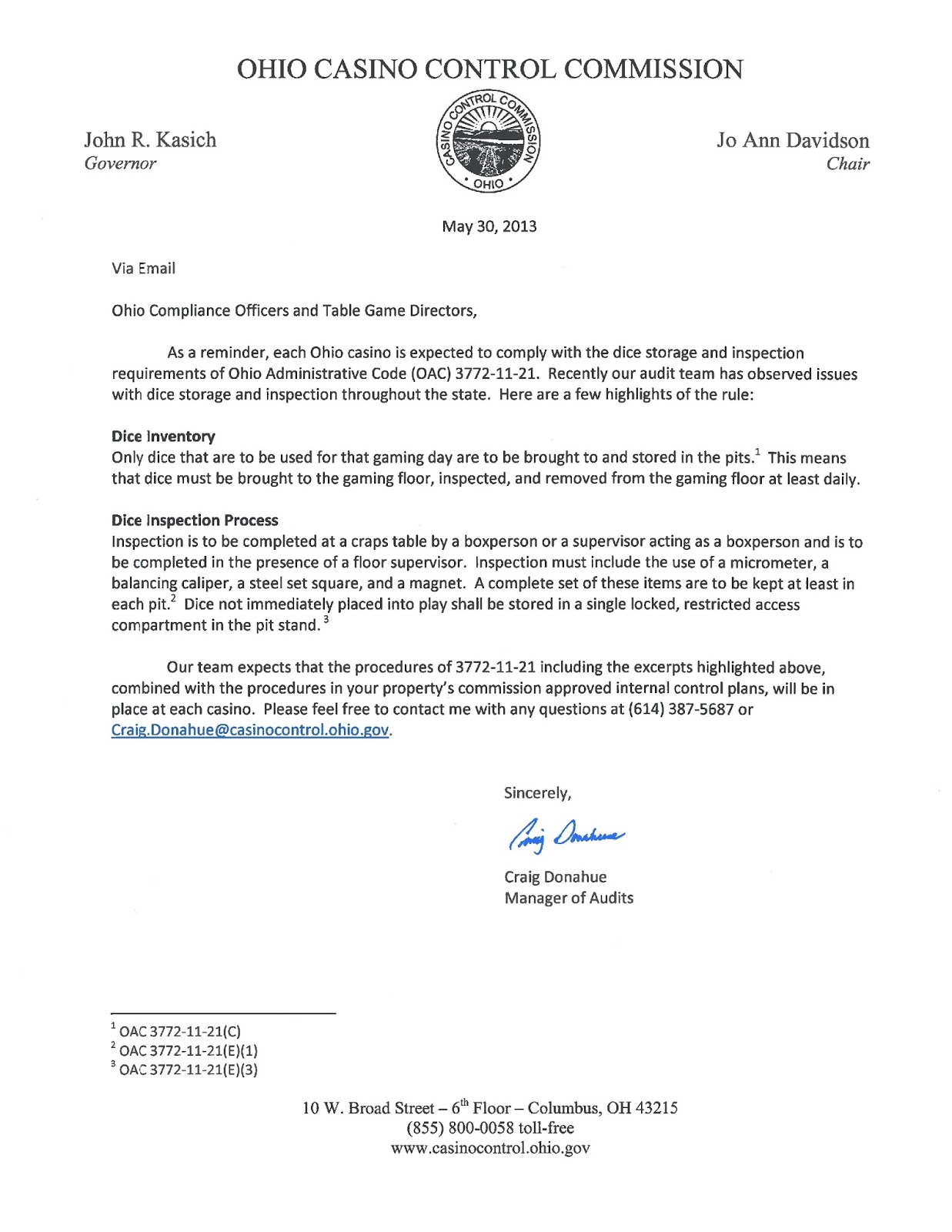
Attachments: 20130530 Donahue to RCOs and TG Directors re Dice Storage and Inspection.pdf
Ohio Compliance Officers and Table Games Directors,
Please see the attached letter concerning dice storage and inspection. Our team has recently identified issues in this area throughout the state. I encourage you to take a look at the procedures you have in place and to ensure that your casino is in compliance with state law and commission approved internal control plans. Please let me know if you have any questions.
As the person that redacted the dates, I can verify that this mass mailing warning about dice problems was sent out before these 2 claims for unbalanced dice in play, so you can see that the Casinos are ignoring the Commission's lip service that is just being done for show, not substance. Hence, complete fiduciary malfeasance by the Gaming Commissions .... as Lena Moffitt warned us:
"These are agencies that have a very cozy relationship with the industries they're regulating."
You make your own conclusions !!



 AND
AND